EN
Why Human Governance Remains Critical in the AI Era
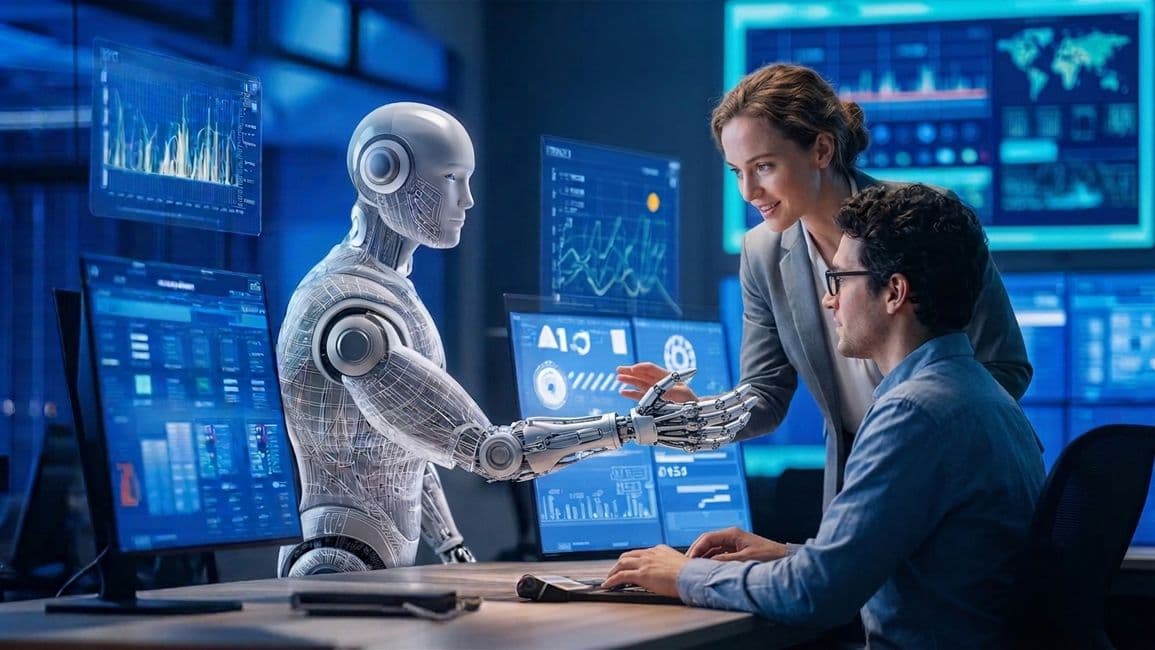
Automation is one of the most-discussed topics in business today, and as the conversation grows more technical, it keeps overlooking the factor that decides whether any of it works: people. After three decades of building and integrating technology for organizations across the Southern Caucasus and Central Asia, one lesson stands out at Bestcomp Group: the greatest value of AI is not in replacing people, but in using machine capability to extend what people can do.
As artificial intelligence spreads across industries, businesses face both an opportunity and a responsibility to keep people at the center of innovation. AI can lift productivity sharply by absorbing repetitive, time-consuming work. But the success of any AI-driven system still depends on human involvement. From complex decisions to ethical judgment, people supply the context, flexibility and accountability that technology on its own cannot. What lets innovation, creativity and responsibility advance together is not the handover of control to machines, but a strong partnership between people and machines.
Keeping people at the center pays off
When routine and mechanical tasks move to AI, organizations gain efficiency and free their people for work that demands creativity, strategy and critical thinking. Faster product development, sharper customer engagement, better-informed decisions: automation delivers stronger results precisely because it gives people room to do what only people can.
Those gains compound when human expertise stays inside the system rather than beside it. AI-driven predictive analytics can surface real-time insight that speeds response to market shifts, personalizes customer experience and improves operational agility. Combined with human understanding and professional judgment, that insight becomes something a business can act on with confidence.
Human-centered AI in practice
Human intuition, ethical awareness and contextual understanding create the conditions in which artificial intelligence performs at its best. As AI adoption accelerates, leading organizations recognize that technological capabilities must be guided by human judgment. They are embedding human oversight into AI systems not only to mitigate risk but also to build trust in the technology.
Salesforce is one of the strongest examples of this approach. The company recently introduced Einstein AI, a generative AI platform that integrates large language models into everyday business workflows, delivering predictions, recommendations and conversational assistance. Recognizing AI's growing influence on decision-making, Salesforce also established its Office of Ethical and Humane Use (OEHU) to ensure that the platform is developed and deployed according to clear ethical principles and meaningful human oversight.
The retail sector is facing similar challenges. As one of the industry's leading companies, Walmart is expanding its use of AI to enhance customer service, improve operational efficiency, and increase workforce productivity. At the same time, the company acknowledges the risks posed by AI-generated misinformation, which can lead to customer confusion, financial losses, or legal issues. To address these concerns ‒ particularly in areas where accuracy and accountability are essential ‒ Walmart has integrated human review into critical stages of its AI-driven processes.
A similar trend can be seen in the telecommunications industry. Verizon has established an internal AI Leadership Council composed of experts from legal, security, technology and network operations. The council develops policies focused on ethical AI, privacy protection and risk management, ensuring that human judgment informs every stage of the company's AI strategy.
These examples demonstrate that responsible AI is defined not only by technological capability but also by human oversight and accountability. Through ethics committees, governance teams, and purpose-built oversight mechanisms, organizations are building AI systems in which people remain central to decision-making and the development of trust.
How Bestcomp Group approaches human-centered AI
Reading about human oversight is one thing, embedding it into live systems is another. As a system integrator, we have our own perspective to add to this discussion. At Bestcomp Group, we design, implement and manage the infrastructure and software that power AI solutions. While we leverage the full potential of modern technologies in every project, we recognize that human oversight is essential and we build it in from the very beginning, rather than treating it as an afterthought.
The data centers and infrastructure we deliver are designed with reliability, continuous monitoring and clearly defined human control points in mind, ensuring that the systems supporting AI remain transparent, traceable and accountable. In software development, we embed oversight directly into the workflow through validation stages, audit mechanisms and the ability for human operators to review, approve or override AI-generated outputs before they reach end users.
Through our cybersecurity and risk management services, we treat AI systems as critical assets that must be protected and governed. We help safeguard data privacy, preserve data integrity and address the emerging risks introduced by AI technologies. In addition, through our managed services and IT consulting, we help clients establish practical AI governance frameworks by identifying where human approval is required and integrating those decision points into operational processes.
This is particularly important for the government institutions and enterprises we serve across Azerbaijan, Georgia and Central Asia. In these environments, accuracy, accountability and public trust are not optional, they are fundamental requirements.
Toward a more human-centered operating model
As AI and automation become increasingly integrated into daily business operations, organizations are entering a new phase shaped by thoughtful design, ethical safeguards and meaningful collaboration between people and technology. The conversation is shifting beyond implementation toward long-term impact, reflecting the belief that the methods used to develop technology are just as important as the technology itself.
This evolution represents a more cooperative model of innovation – one in which human insight guides intelligent systems and technology is designed to enhance creativity, adaptability and trust. Rather than being a temporary adjustment, it reflects a lasting transformation in the way businesses operate, compete and grow. Organizations that embrace this philosophy will be better positioned to build systems that are resilient, responsible and responsive to change. When automation is developed with people in mind rather than focused solely on processes, it creates a future that is both highly productive and fundamentally human.

